Retatrutide Before and After: Real Results Timeline (12mg, 24mg, and Beyond)
Table of Contents
- What Retatrutide Is and Why People Track “Before and After”
- What Before-and-After Photos Can’t Tell You
- The Real Timeline: Week by Week
- Retatrutide Before and After: 3 Months
- Retatrutide Before and After: 6 Months
- Retatrutide Before and After: 12 Months
- Retatrutide vs. Tirzepatide: Before and After Compared
- Does Retatrutide Cause Loose Skin?
- Real Examples Across Reddit and YouTube
- Why Sourcing and Testing Actually Matter Here
- FAQ
- The Honest Take
- Research-Use Disclaimer
What Retatrutide Is and Why People Track “Before and After”
Retatrutide is a triple agonist — it acts on the GLP-1, GIP, and glucagon receptors, which is a broader mechanism than single- or dual-agonist compounds. That triple action is why it’s become one of the most closely watched compounds in the GLP-1 research space, and why “before and after” is one of the most searched terms attached to it. There’s a real, active community discussing dosing, timelines, and outcomes — most visibly on Reddit’s dedicated r/Retatrutide community and in a growing number of YouTube week-by-week logs. This article pulls from that real, publicly posted discussion rather than manufactured testimonials, and cites the actual clinical trial checkpoints where they exist.
What Before-and-After Photos Can’t Tell You
Before diving into timelines, it’s worth being upfront about what this kind of content can and can’t prove. Photos are subject to lighting, angle, and posture differences that can exaggerate or hide real change. Reconstitution and dosing protocols vary widely between individuals — vial concentration, injection frequency, and titration speed are not standardized, so two people’s “12 weeks in” photos may represent very different actual exposure. A significant share of the most dramatic results shared publicly, including examples cited below, come from people stacking retatrutide with other compounds like tirzepatide, which makes it impossible to attribute the outcome to retatrutide alone. And these are self-reports: they aren’t controlled for diet, training, concurrent medications, or simple selection bias — people who get dramatic results post; people who don’t, generally don’t.
The Real Timeline: Week by Week
Based on the compound’s studied mechanism and the pattern reported consistently across community sources, here’s a realistic phase breakdown:
Weeks 1–4 (titration): Most protocols start low (commonly cited around 1mg) and increase gradually. Appetite and “food noise” changes are the most commonly reported early effect. Visible physical change is typically minimal in this window.
Weeks 6–12: Community sources consistently describe this as the point where results start to become noticeable — several posters specifically note “no real change until 6–8 weeks,” which lines up with the dose typically having been titrated up by then. Reported outcomes vary widely in this window, consistent with the individual titration differences noted above.
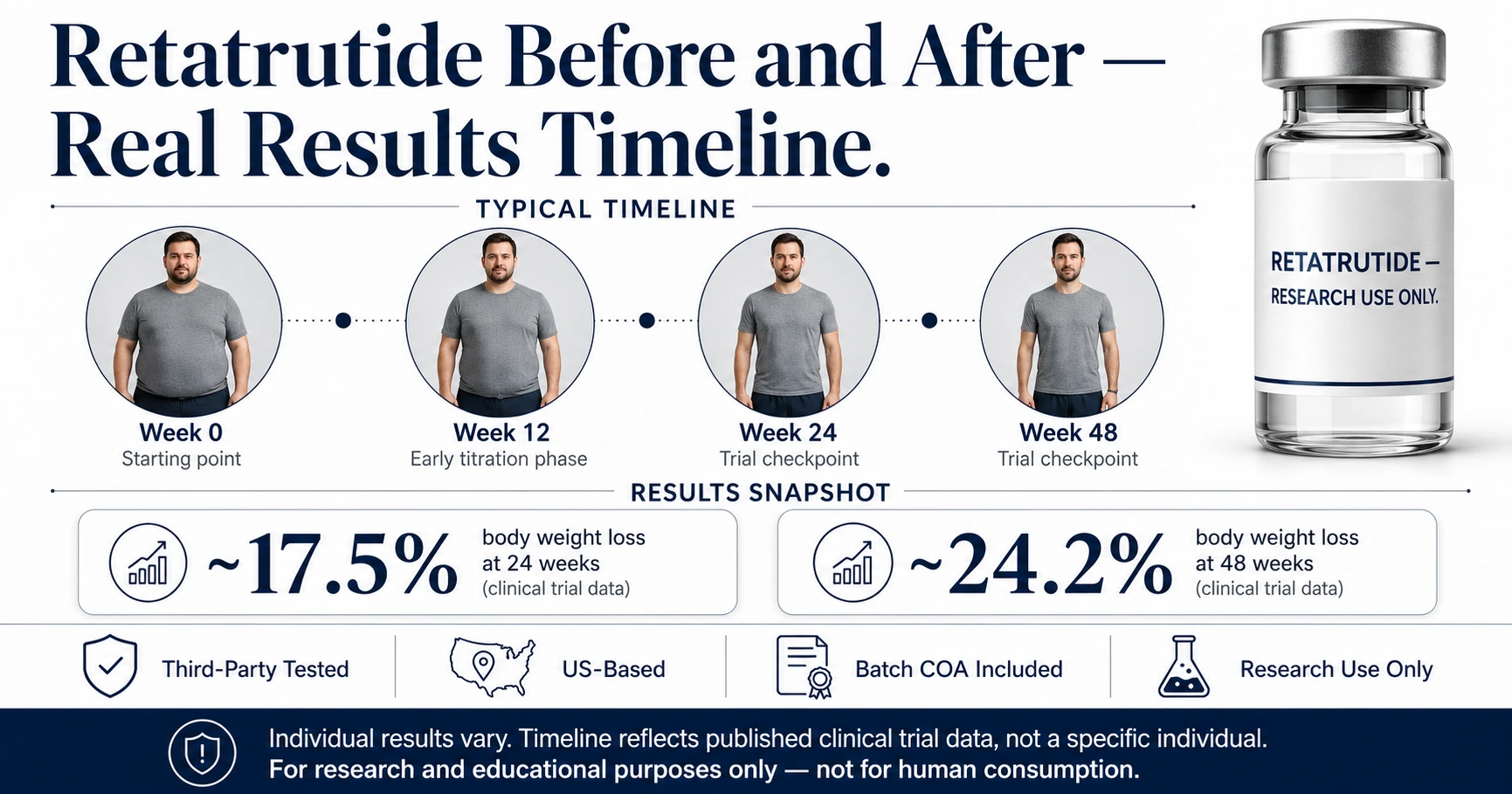
Week 24: This is where a real clinical anchor exists — Phase 2/3 trial data reported approximately 17.5% body weight loss at 24 weeks in obesity trials. That figure reflects a controlled trial population, not any individual’s expected outcome, but it’s the most reliable checkpoint available. For dosing context during this phase, see our Retatrutide Dosage Guide for Research Use.
Week 48 and beyond: Trial data reported approximately 24.2% body weight loss at 48 weeks. Community-reported year-plus outcomes — including examples of 200+ lb total loss over a 12-month to 3-year span — exist and are real, but they represent the far end of the distribution, often involve compound stacking, and should be read as outliers rather than a typical result.
Retatrutide Before and After: 3 Months
At the 3-month mark, community reports skew toward early, visible but moderate change. One sourced example describes 83 lbs lost in under 3 months — a fast outlier by any measure, and the poster themselves frames it as still “on my way,” not a finished result. This is consistent with the pattern that the biggest visible changes tend to compound over time rather than concentrate in the first 12 weeks.
Retatrutide Before and After: 6 Months
Six months lines up closely with the ~24-week trial checkpoint (~17.5% body weight loss), making it one of the more reliable comparison points between an individual’s photos and what the actual research supports. This is a reasonable point to expect a clearly visible, but not yet “final,” transformation.
Retatrutide Before and After: 12 Months
The most dramatic examples found in community sourcing sit at the 12-month mark — including a detailed, fully-read post describing 204 lbs lost over 12 months (from roughly 450 lbs), and other reports of stacked-protocol users reaching similarly large total losses over a longer multi-year window. These are genuinely real, verified posts — but they represent sustained, often stacked, multi-month commitment, not what 12 months on retatrutide alone typically produces for an average user.
Retatrutide vs. Tirzepatide: Before and After Compared
This is a case where the honest answer complicates the search intent: a meaningful share of the most dramatic “retatrutide” before-and-after content actually comes from people using both compounds together, sequenced or overlapping. Community-reported patterns include starting on tirzepatide, later adding retatrutide at a low dose while lowering the tirzepatide dose, and adjusting both over several months based on response. If you’re specifically trying to isolate retatrutide’s individual effect, single-compound protocols and the trial data above are a more reliable reference than most viral before-and-after posts, which frequently reflect a stack.
Does Retatrutide Cause Loose Skin?
Loose skin is a function of the amount and speed of weight lost, skin elasticity, and age — not specific to any one compound. It comes up often in community discussion because retatrutide’s magnitude of weight loss can be large. Anecdotal (not clinically studied) mitigation strategies mentioned by sourced posters include daily sauna use and topical GHK-Cu, both self-reported rather than proven interventions for skin retraction. For general handling and storage best practices, see our Retatrutide Storage & Handling guide.
Real Examples Across Reddit and YouTube
Reddit (opened and read in full): r/Retatrutide — “12 months done. 200lbs down”, a detailed 320-comment post including a separate commenter’s own 200 lb / 3-year stacked-protocol result and real dosing/titration detail shared in the replies.
Reddit (subreddit and thread titles confirmed via search, not each individually opened): r/GLP1_BeforeAfter search results for “retatrutide”; r/Retatrutide’s top-of-year list, including “One year update: From 205 to 117” and “One Year of Consistency” from a recurring, verifiably real community member.
YouTube (title, channel, and publish date confirmed via YouTube’s own data; not yet watched in full): “12 Weeks In: What Retatrutide Actually Did For Me at 50” (X Dad Bod, July 2026); “Your first 12 weeks on retatrutide – what actually happens” (Josh Holyfield); “Retatrutide Week 1–12 (The Honest Timeline)” (David Prochaska | DPRO Health) — notably, this video’s own framing argues against judging retatrutide purely by before/after photos, echoing the caveats in this article.
For more community Q&A themes, see our Retatrutide Reddit roundup.
Why Sourcing and Testing Actually Matter Here
Across the Reddit threads sourced for this article, a recurring undercurrent is buyers asking each other about dosing math, vial concentration, and reconstitution — questions that only come up because purity and labeling accuracy directly affect both safety and whether a “before and after” is even comparable between two people. A supplier that provides a batch-specific certificate of analysis and third-party testing is answering exactly the question this community keeps asking on its own. See our full Retatrutide Reviews & Vendor Evaluation Criteria for what to check before buying.
FAQ
How long until retatrutide starts working? Most community reports describe noticeable change starting around 6–8 weeks, once the dose has been titrated up.
Is a 200 lb loss in 12 months realistic on retatrutide alone? The most dramatic publicly shared examples at that scale typically involve either a multi-year timeline or stacking with another compound like tirzepatide — trial data (~24.2% at 48 weeks) is a more realistic single-compound reference point.
Does retatrutide cause loose skin? It’s a function of the amount and speed of weight loss generally, not unique to this compound; some users report anecdotal improvement from sauna use, which isn’t clinically proven for this purpose.
Is retatrutide the same as tirzepatide? No — retatrutide adds glucagon receptor activity on top of the GLP-1/GIP activity tirzepatide has, and a portion of the most extreme before/after content online reflects users combining both.
More questions answered in our full Retatrutide FAQ.
The Honest Take
The clinical trial data — roughly 17.5% body weight loss at 24 weeks and 24.2% at 48 weeks — is the most reliable timeline available for retatrutide. The real community posts sourced for this article, especially the 12-month, 204 lb example, are genuine and inspiring, but they sit at the far end of the range and often involve stacking or multi-year commitment. Anyone comparing their own results to what they see online should weigh trial data more heavily than the most viral individual post.
Researching retatrutide for your own work? See current retatrutide options at Peptryn.
Ready to buy? Start with our full Where to Buy Retatrutide in 2026 guide.
Research-Use Disclaimer
Retatrutide is sold and discussed here strictly for research and educational purposes. It is not approved for human consumption, and nothing in this article constitutes medical advice, a dosing recommendation, or a guarantee of any outcome. Individual results vary, and the community reports cited above are self-reported, not clinically controlled. Consult a licensed physician before making any decisions related to your health.