How to Reconstitute Retatrutide: Bac Water, Math, and Storage (Step-by-Step)
Table of Contents
- Why This Is One of the Most-Asked Retatrutide Questions
- What Reconstitution Actually Means
- The Math, Explained Simply: Units vs. mg vs. mL
- Step-by-Step Reconstitution Process
- How Much Bac Water Per Vial Size
- What Water to Use (and What to Avoid)
- How Long a Reconstituted Vial Actually Lasts
- Common Mistakes People Ask About
- Real Questions From the Research Community
- FAQ
- The Honest Take
- Research-Use Disclaimer
Why This Is One of the Most-Asked Retatrutide Questions
“How to reconstitute retatrutide” and “how much bac water” are among the most consistently searched retatrutide questions there are — and the research community backs that up directly. On Reddit’s dedicated r/Retatrutide community alone, dozens of near-identical threads get posted every month: “How much BAC water for a 20mg vial,” “30mg Reta — how much BAC water,” “Trouble with reconstitution math,” and so on, going back over a year. It’s clearly one of the single biggest points of confusion for anyone new to research peptides, so this guide walks through it plainly, with worked examples.
What Reconstitution Actually Means
Retatrutide is supplied as a lyophilized (freeze-dried) powder in a sealed vial. It has to be mixed with a liquid — almost always bacteriostatic water — before it can be drawn into a syringe. Reconstitution doesn’t add or remove any active peptide; it just dissolves the existing powder into a liquid so it becomes measurable and usable. However much bacteriostatic water you add, the vial still contains exactly the same total mg of peptide it started with — you’re just changing the concentration (how much peptide is in each mL or unit of liquid).
The Math, Explained Simply: Units vs. mg vs. mL
This is where most confusion comes from, and it’s a recurring theme across real community threads. Three different measurements get mixed up constantly:
- Dose — measured in mg (milligrams). This is the actual amount of active peptide.
- Volume — measured in mL (milliliters) or units on an insulin syringe. 1mL = 100 units on a standard U-100 syringe. This is not a measure of dose by itself — it only becomes one once you know the concentration.
- Concentration — how many mg are in each mL (or unit) once the vial is mixed. This is what actually connects volume to dose.
The community explanation that comes up most often boils down to this: decide how many total doses you want to get out of the vial, then pick a bac water volume that divides evenly into round, easy-to-draw unit numbers. For example, a 12mg vial split into 1mg doses is 12 doses total — add enough bac water that each dose lands on a clean number of units (say, 10 units = 1mg), and every future dose becomes simple arithmetic instead of guesswork.
Step-by-Step Reconstitution Process
- Wipe the rubber stopper on the vial with an alcohol wipe before touching it with a needle.
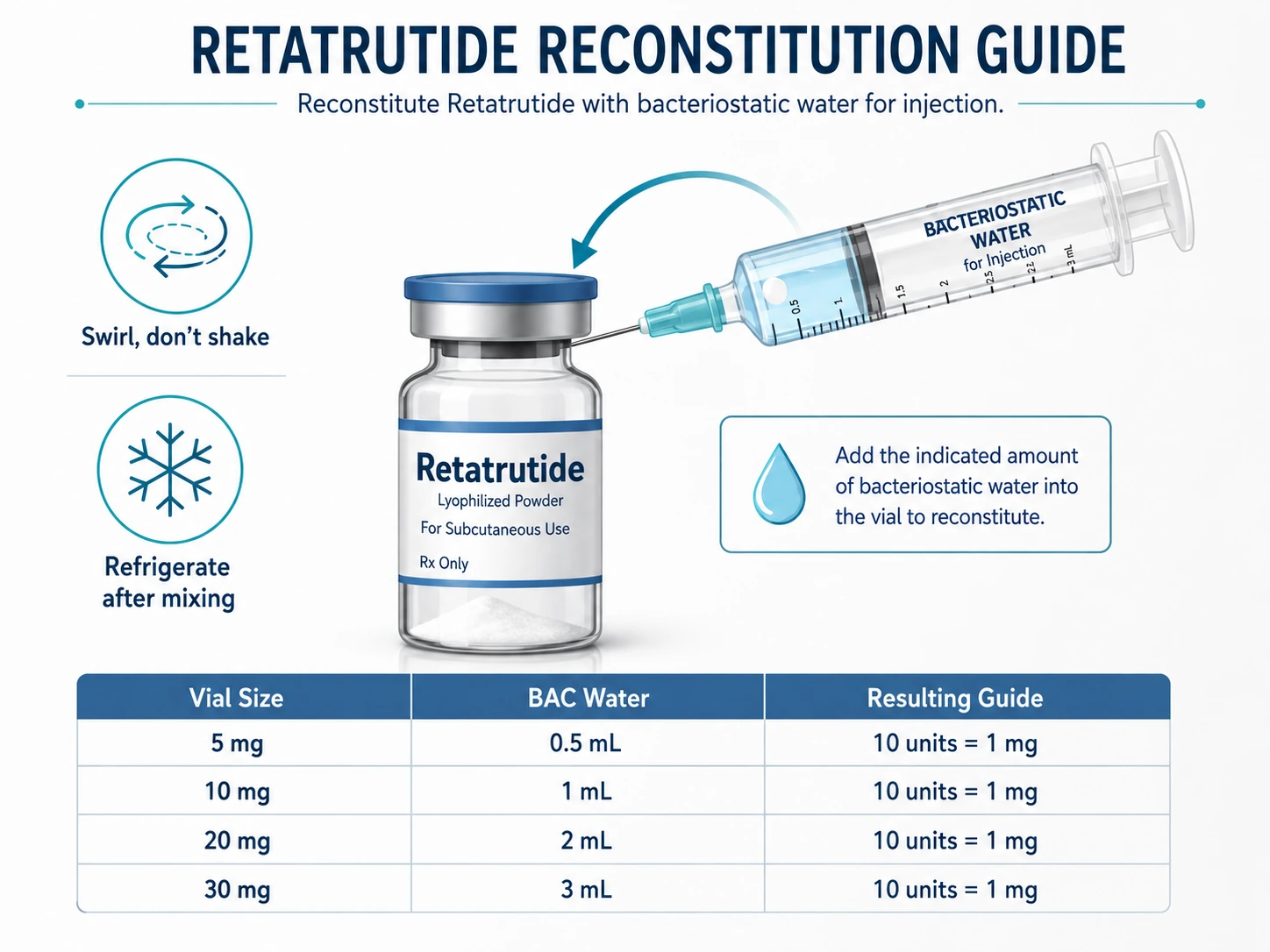
- Draw your chosen amount of bacteriostatic water into a syringe (see the table below for common starting points).
- Inject the water into the vial slowly, aiming down the inside wall of the glass rather than directly onto the powder, to avoid excess foaming.
- Gently swirl (don’t shake) the vial until the powder is fully dissolved. The solution should end up clear, not cloudy.
- Label the vial with the date it was mixed and the resulting concentration (e.g., “10mg/1mL = 10 units per mg”) so you’re not doing mental math every time.
- Store the reconstituted vial in the refrigerator, not the freezer, and not the refrigerator door where temperature fluctuates most.
How Much Bac Water Per Vial Size
There’s no single “correct” amount — it’s a trade-off between injection volume and how fine-grained your dosing control is. These are common starting points researchers discuss, aimed at keeping doses on round unit numbers with a U-100 (1mL = 100 unit) syringe:
| Vial Size | Common Bac Water Amount | Resulting Concentration |
|---|---|---|
| 5mg | 0.5mL | 1mg = 10 units |
| 10mg | 1mL | 1mg = 10 units |
| 15mg | 1.5mL | 1mg = 10 units |
| 20mg | 2mL | 1mg = 10 units |
| 30mg | 3mL | 1mg = 10 units |
Keeping “10 units per 1mg” consistent across vial sizes (by scaling the water 1:1 with the mg amount) is the pattern that comes up most often in community discussion, since it means the math doesn’t change every time you get a new vial. Some researchers use less water for a more concentrated, lower-volume injection, or more water for finer dosing control at very low doses — both are discussed in the community, and the right answer depends on your own syringe and comfort with the resulting injection volume.
What Water to Use (and What to Avoid)
Bacteriostatic water — water with a small amount of benzyl alcohol added as a preservative — is the standard choice, and for good reason: it’s what allows a vial to be safely punctured multiple times over several weeks without contamination risk. Community discussion consistently favors pharmaceutical-grade, batch-tested bacteriostatic water over generic or unverified sources. Two things to specifically avoid using instead: plain sterile water (fine for a single draw, but it has no preservative, so a multi-use vial is left unprotected after the first puncture), and saline, which is generally considered unsuitable for this kind of reconstitution.
How Long a Reconstituted Vial Actually Lasts
There’s no hard cliff-edge expiration once a vial is mixed, but it isn’t indefinite either. Community-compiled degradation data (referencing third-party bacteriostatic-water stability testing) puts it around 5% degradation by roughly the 45-day mark, climbing to around 10% by the 90-day mark. Practical signs a reconstituted vial should be discarded regardless of the calendar: it turns cloudy, develops any floating particles, or the rubber stopper hasn’t been wiped with alcohol before each draw. Clear and clean is the baseline to look for. For the full before-reconstitution storage picture (temperature, light, and shelf life of the unmixed powder), see our Retatrutide Storage & Handling guide.
Common Mistakes People Ask About
A few patterns show up repeatedly in real community questions: injecting the bac water directly onto the powder instead of down the vial wall (causes excessive foaming and can make it harder to judge when it’s fully dissolved); not labeling the vial with the mixed concentration and losing track of the math a few weeks later; and confusion specifically around pre-blended multi-compound vials, where two components with different typical dosing schedules are mixed in one vial — in that case, the combined concentration applies to both components simultaneously, so the total volume drawn covers both compounds’ doses at once, not each independently.
Real Questions From the Research Community
Reddit (opened and read in full): r/Retatrutide’s pinned “Beginners Guide 2026” (983 points, 294 comments) includes a detailed reconstitution-math walkthrough, bacteriostatic-water brand guidance, and the degradation timeline referenced above. A separate widely-upvoted post, “Jesus christ people – enough asking how much bac water” (122 points, 56 comments), breaks down the units/mg/mL relationship in plain terms using a worked 12mg-vial example.
Reddit (thread pattern confirmed via direct search, representative examples opened): dozens of individual “how much bac water for [X]mg vial” threads — 5mg, 10mg, 12mg, 15mg, 20mg, 30mg, 35mg, and 48mg vials all show up as separate, recent, real posts, confirming this is a recurring, high-volume point of confusion rather than a one-off question.
YouTube (title, channel, and publish date confirmed; not yet watched in full): “How to Mix Retatrutide | Beginner’s Guide (Dosing & Mistakes to Avoid)” (Jack Cooper); “How to Reconstitute Retatrutide with an Insulin Syringe” (Carter Blaise); “Reconstitution Retatrutide: How to properly reconstitute your GLP1 Peptides” (The Peptide Couple).
FAQ
How much bac water should I add to my retatrutide vial? There’s no single mandatory amount — it’s a trade-off between injection volume and dosing precision. A common community pattern is roughly 0.1mL of bac water per 1mg of peptide (so a 10mg vial gets about 1mL), which keeps “10 units per 1mg” consistent and easy to calculate.
Do I need to use Hospira-brand bacteriostatic water specifically? No specific brand is mandatory, but pharmaceutical-grade, batch-tested bacteriostatic water is consistently preferred in community discussion over unverified sources, given it’s a preservative-containing solution you’re relying on for a multi-week, multi-use vial.
How long does reconstituted retatrutide last? Community-referenced degradation data points to roughly 5% degradation around 45 days and 10% around 90 days when properly refrigerated. Cloudiness or visible particles are a sign to discard it regardless of how many days it’s been.
Can sterile water be used instead of bacteriostatic water? It can technically dissolve the powder, but it has no preservative, so a vial reconstituted with sterile water isn’t protected against contamination across repeated punctures the way a bacteriostatic-water vial is.
The Honest Take
The reconstitution math looks more intimidating than it actually is — the confusion almost always comes from mixing up dose (mg), volume (mL/units), and concentration (mg per mL), not from the arithmetic itself. Pick a bac water amount that keeps your math on round numbers, label the vial the moment you mix it, and store it properly, and the rest is routine. For dosing context once your vial is mixed, see our Retatrutide Dosage Guide for Research Use. If you’re weighing retatrutide against other GLP-1/GIP compounds before committing to a protocol, see our retatrutide vs. tirzepatide vs. semaglutide comparison. For the full technical protocol — including a step-by-step walkthrough and concentration math for research records — see Peptryn’s official retatrutide reconstitution protocol.
Sourcing a batch worth mixing correctly matters just as much as the math — understanding realistic pricing before you buy matters too. See our retatrutide price & cost guide, or see current retatrutide options at Peptryn.
Research-Use Disclaimer
Retatrutide is sold and discussed here strictly for research and educational purposes. It is not approved for human consumption, and nothing in this article constitutes medical advice or a dosing recommendation. Reconstitution and dosing information reflects community-reported practices, not clinical guidance. Consult a licensed physician before making any decisions related to your health.