Retatrutide Side Effects: What Research and Real Reports Show
Table of Contents
- What Clinical Trial Data Actually Shows
- The Most Common Side Effects
- Why Side Effects Cluster Early
- What the Research Community Reports
- Less Common Reports Worth Knowing About
- Signs Worth Paying Attention To
- FAQ
- The Honest Take
- Research-Use Disclaimer
What Clinical Trial Data Actually Shows
Retatrutide’s Phase 2 trial results were published by Jastreboff et al. in the New England Journal of Medicine in June 2023 — the most credible source available on its studied safety profile, run under medical supervision at controlled dose levels. That trial reported an adverse-event profile consistent with what’s expected from a GLP-1/GIP/glucagon receptor agonist: predominantly gastrointestinal, dose-dependent, and concentrated in the early dose-escalation phase (roughly weeks 1–12).
The headline numbers at the highest studied dose (12mg): nausea in roughly 47% of participants (rising from about 14% at the lowest 1mg dose), vomiting in about 21%, and diarrhea in the 24–33% range. The trial’s own framing is important context — these events were “predominantly mild to moderate in severity” and tended to resolve with continued dosing, and starting at a lower dose (2mg vs. 4mg) measurably reduced how often they occurred.
The Most Common Side Effects
Across the trial data, the pattern is consistently gastrointestinal:
- Nausea — the most frequently reported event, and the most dose-dependent (roughly 14% at 1mg climbing to roughly 60% at the highest studied dose in some reporting breakdowns).
- Vomiting — reported in roughly a fifth of participants at the highest dose studied.
- Diarrhea — reported at broadly similar frequency to vomiting at higher doses.
- Constipation — also reported, though less consistently emphasized across trial summaries than the three above.
This lines up with the broader class of GLP-1/GIP/glucagon agonists, where gastrointestinal effects are the dominant category across the board — retatrutide’s triple-receptor mechanism doesn’t appear to introduce a fundamentally different side-effect category, just a different intensity profile at comparable doses.
Why Side Effects Cluster Early
Trial data specifically calls out the dose-escalation phase — the first several weeks, before a research protocol reaches its target dose — as where gastrointestinal events concentrate. This is consistent with how this receptor class is generally understood to behave: the GI tract’s response is most pronounced when a new, higher concentration is introduced, and tends to moderate somewhat as dosing continues at a stable level. The trial’s own comparison between a 2mg and 4mg starting dose showing a measurable difference in reported events reinforces that the escalation curve itself, not just the eventual target dose, is a meaningful variable.
What the Research Community Reports
Trial data is the most rigorous source available, but it’s collected under controlled, medically supervised conditions at specific protocol doses — not the same as open community discussion, which is far more variable and unfiltered. Reading real threads directly (not a search tool’s summary of them) gives a useful second data point on how these effects are actually experienced and discussed:
- A thread asking how others manage nausea reflects how common a topic this is in the community — it’s one of the most frequently recurring questions in the subreddit, consistent with trial data showing nausea as the single most-reported event.
- Reports vary widely in severity and duration. Some describe nausea as a short-lived early hurdle; others describe it persisting months into a research cycle alongside reflux, which is a notably longer timeline than the trial’s “predominantly weeks 1–12” framing would suggest is typical.
- Some reports describe more severe presentations — one thread describes nausea severe enough to interfere with eating, at the more intense end of what trial data would categorize as a reportable adverse event rather than a mild, transient one.
- Side effects aren’t always isolated to the GI tract in community reports — one first-timer’s thread describes muscle cramps and anxiety reported alongside nausea after a second dose. Worth noting: community self-reports like this aren’t controlled for other contributing factors, so a reported association isn’t the same as a demonstrated cause.
None of this is dosing guidance, and nothing here should be read as a recommendation to manage or push through a side effect a certain way — it’s a record of what’s actually being discussed, for context alongside the trial data above.
Less Common Reports Worth Knowing About
Beyond the core GI cluster, community discussion occasionally surfaces less common reports — fatigue, mood-adjacent changes, and reflux persisting well past the trial’s typical early-weeks window. These show up far less frequently than nausea/vomiting/diarrhea in both the trial data and community discussion, and self-reported, unblinded accounts like this can’t establish that retatrutide specifically caused them rather than something else going on at the same time. They’re included here for completeness, not because they’re common.
Signs Worth Paying Attention To
Trial data and community discussion both point to gastrointestinal symptoms as the expected, most likely category of side effect — and both describe most of them as mild-to-moderate and transient. Symptoms that are severe, that prevent normal eating or hydration, or that persist well beyond the early weeks of a research protocol fall outside that typical pattern and are the kind of thing worth discussing with a licensed physician rather than managing independently. This article is not a substitute for that conversation.
FAQ
What is the most common retatrutide side effect? Nausea, by a wide margin, according to both Phase 2 trial data and community discussion — followed by vomiting and diarrhea.
Do side effects get better over time? Trial data suggests most gastrointestinal events concentrate in the early dose-escalation phase (roughly weeks 1–12) and are typically mild-to-moderate and transient. Community reports show a wider range, including some describing symptoms persisting well beyond that window.
Does a lower starting dose reduce side effects? Trial data specifically compared a 2mg vs. 4mg starting dose and found the lower starting dose was associated with fewer reported gastrointestinal events during escalation.
Are retatrutide’s side effects different from semaglutide or tirzepatide? The side-effect category (gastrointestinal) is broadly consistent across this class of GLP-1/GIP/glucagon receptor agonists. Retatrutide adds glucagon receptor activity on top of the GLP-1/GIP mechanism shared with tirzepatide, but published data doesn’t show a fundamentally different side-effect category as a result — more a matter of relative intensity at comparable doses.
The Honest Take
The clearest signal across both the trial data and real community discussion is the same: gastrointestinal effects, nausea most of all, are the expected and most likely thing to encounter, they’re dose-dependent, and they cluster early. Where the two sources diverge is in the tail — trial data (collected under medical supervision, with dose-escalation protocols designed partly to manage this) shows a fairly contained, mostly-resolves-by-week-12 picture, while open community discussion shows a wider range including a meaningful number of longer, more severe reports. Both are worth reading before assuming your own experience will land at either end.
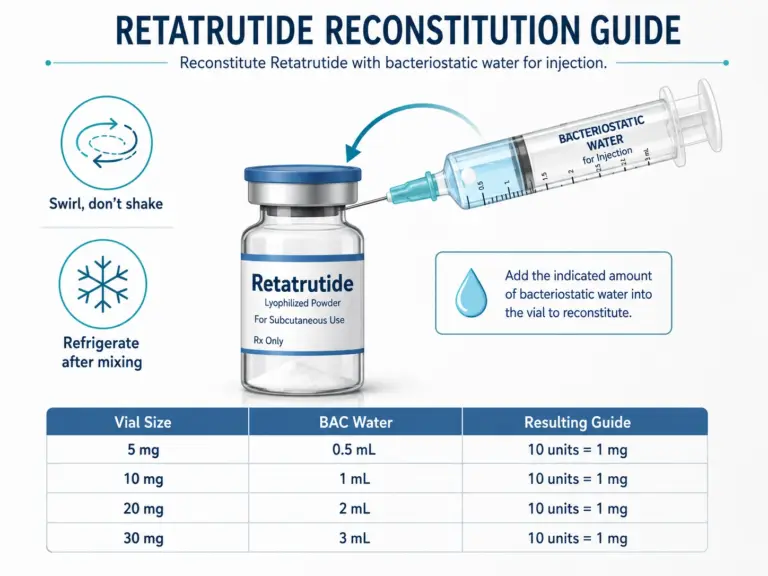
Source quality is a variable in its own right here too — batch consistency and verified purity affect what you’re actually researching with. See our dosage guide and reconstitution guide for the related practical side of this, and our buyer’s guide for how to evaluate a source before ordering.
Source a lab-verified batch with COA included
Related guides
- Retatrutide dosage guide for research use
- How to reconstitute retatrutide (bac water & math)
- Where to buy retatrutide: complete buyer’s guide
- Full FAQ: buying, legality, dosing & more
Research-Use Disclaimer
This article summarizes published Phase 2 trial data and real, publicly available community discussion for research and informational purposes only. It is not medical advice, and nothing here constitutes a recommendation about how to use, dose, or manage side effects from this compound. Retatrutide is not approved by the FDA for human use and is sold strictly for laboratory research by qualified individuals. Consult a licensed physician before making any decisions related to your health.